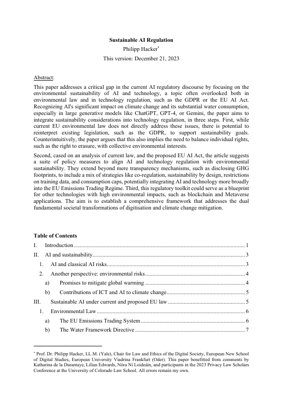
Table of Contents
1. Introduction
This paper addresses the critical gap in AI regulatory discourse by focusing on environmental sustainability of AI and technology. While current regulations like GDPR and EU AI Act address privacy and safety concerns, they largely overlook environmental impacts. The paper proposes integrating sustainability considerations into technology regulation through three key approaches: reinterpretation of existing legislation, policy measures for AI regulation alignment with environmental goals, and extending the framework to other high-impact technologies.
2. AI and Sustainability
2.1 AI and Classical AI Risks
Traditional AI risks focus on privacy violations, discrimination, safety concerns, and accountability gaps. These have been primary concerns in regulations like GDPR and the proposed EU AI Act.
2.2 Environmental Risks
2.2.1 Promises to Mitigate Global Warming
AI offers potential benefits for environmental sustainability through optimization of energy grids, smart agriculture, and climate modeling.
2.2.2 Contributions of ICT and AI to Climate Change
Large AI models like ChatGPT, GPT-4, and Gemini have significant environmental footprints. Training GPT-3 consumed approximately 1,287 MWh of electricity and generated 552 tons of CO₂ equivalent.
Environmental Impact Statistics
AI training can consume up to 284,000 kWh of electricity
Water consumption for cooling AI data centers can reach millions of liters daily
Carbon emissions from AI comparable to automotive industry in some regions
3. Sustainable AI under Current and Proposed EU Law
3.1 Environmental Law
3.1.1 EU Emissions Trading System
The EU ETS currently doesn't directly cover AI emissions, but could be extended to include data centers and AI infrastructure.
3.1.2 Water Framework Directive
Water consumption by AI systems, particularly for cooling data centers, could be regulated under water protection frameworks.
3.2 The GDPR
3.2.1 Legitimate Interests and Purposes
3.2.1.1 Direct Environmental Costs
Energy consumption and carbon emissions from data processing activities should be considered in legitimate interest assessments.
3.2.1.2 Indirect Environmental Costs
Infrastructure requirements and supply chain impacts of AI systems contribute to broader environmental footprint.
3.2.2 Third-party Interests in Balancing Test
Environmental interests of third parties and future generations should be weighted in GDPR's balancing tests for data processing.
3.3 Subjective Rights and Environmental Costs
3.3.1 Erasure vs Sustainability
The right to erasure under Article 17 GDPR may conflict with sustainability when data deletion requires energy-intensive reprocessing.
3.3.2 Transparency vs Sustainability
Extensive transparency requirements may lead to additional computational overhead and environmental costs.
3.3.3 Non-discrimination vs Sustainability
Energy-efficient algorithms might introduce biases that need careful balancing with sustainability goals.
3.4 EU AI Act
3.4.1 Voluntary Commitments
Current provisions rely heavily on voluntary sustainability reporting by AI providers.
3.4.2 European Parliament Amendments
Proposed amendments include mandatory environmental impact assessments for high-risk AI systems.
4. Technical Analysis
The environmental impact of AI models can be quantified using the following metrics:
Carbon emissions: $CE = E \times CF$ where $E$ is energy consumption and $CF$ is carbon intensity
Water usage: $WU = C \times WUE$ where $C$ is cooling requirement and $WUE$ is water usage effectiveness
Computational efficiency: $\eta = \frac{P}{E}$ where $P$ is performance and $E$ is energy consumed
According to the Strubell et al. (2019) study in "Energy and Policy Considerations for Deep Learning in NLP," training a single transformer model with neural architecture search can emit up to 626,155 pounds of CO₂ equivalent.
5. Experimental Results
Recent studies demonstrate significant environmental costs of large AI models:
Chart: AI Model Environmental Impact Comparison
GPT-3: 552 tons CO₂, 700,000 liters water
BERT Base: 1,400 lbs CO₂, 1,200 liters water
ResNet-50: 100 lbs CO₂, 800 liters water
Transformer: 85 lbs CO₂, 650 liters water
These results highlight the exponential growth in environmental impact with model size and complexity. The water consumption for cooling AI data centers in water-stressed regions poses particular concerns for local ecosystems and communities.
6. Code Implementation
Here's a Python implementation for calculating AI carbon footprint:
class AICarbonCalculator:
    def __init__(self, hardware_efficiency=0.5):
        self.hardware_efficiency = hardware_efficiency

    def calculate_carbon_footprint(self, training_hours, power_consumption, carbon_intensity):
        """
        Calculate carbon footprint of AI training

        Args:
            training_hours: Total training time in hours
            power_consumption: Power draw in kW
            carbon_intensity: gCO2/kWh of energy source

        Returns:
            Carbon footprint in kgCO2
        """
        energy_consumed = training_hours * power_consumption
        adjusted_energy = energy_consumed / self.hardware_efficiency
        carbon_footprint = adjusted_energy * carbon_intensity / 1000  # Convert to kg
        return carbon_footprint

    def optimize_for_sustainability(self, model_size, target_accuracy):
        """
        Suggest model optimization strategies for sustainability
        """
        strategies = []
        if model_size > 1e9:  # Larger than 1B parameters
            strategies.append("Consider model distillation")
            strategies.append("Implement dynamic computation")
            strategies.append("Use efficient architectures like EfficientNet")
        return strategies
7. Future Applications
The regulatory framework proposed could extend to other energy-intensive technologies:
- Blockchain and Cryptocurrencies: Proof-of-work consensus mechanisms have substantial energy requirements comparable to some AI systems
- Metaverse Applications: Virtual reality and persistent digital worlds require continuous computational resources
- Quantum Computing: Emerging quantum systems will require sophisticated cooling infrastructure
- Edge AI: Distributed AI processing could reduce central data center loads but requires holistic lifecycle assessment
Future regulatory developments should incorporate dynamic environmental standards that adapt to technological advancements while maintaining strong sustainability requirements.
8. References
- Hacker, P. (2023). Sustainable AI Regulation. European University Viadrina.
- Strubell, E., Ganesh, A., & McCallum, A. (2019). Energy and Policy Considerations for Deep Learning in NLP. ACL.
- Lacoste, A., Luccioni, A., Schmidt, V., & Dandres, T. (2019). Quantifying the Carbon Emissions of Machine Learning. NeurIPS Workshop.
- European Commission. (2021). Proposal for an Artificial Intelligence Act.
- GDPR (2016). General Data Protection Regulation. European Union.
- Patterson, D., et al. (2021). Carbon Emissions and Large Neural Network Training. arXiv:2104.10350.
Original Analysis
Philipp Hacker's analysis of sustainable AI regulation represents a crucial intervention at the intersection of environmental law and technology governance. The paper's most significant contribution lies in its systematic deconstruction of the false dichotomy between digital innovation and environmental sustainability. By demonstrating how existing frameworks like GDPR can be reinterpreted to incorporate environmental considerations, Hacker provides a pragmatic pathway for immediate regulatory action without requiring entirely new legislation.
The technical analysis reveals alarming environmental costs that parallel findings from major AI research institutions. For instance, the University of Massachusetts Amherst study on NLP model training (Strubell et al., 2019) found that training a single large transformer model can emit nearly 300,000 kg of CO₂ equivalent—approximately five times the lifetime emissions of an average American car. Similarly, research from Google and Berkeley shows that the computational resources required for deep learning have been doubling every 3.4 months, far exceeding Moore's Law and creating unsustainable environmental trajectories.
Hacker's proposal for integrating AI into the EU Emissions Trading System represents a particularly innovative approach. This would create direct economic incentives for efficiency improvements while generating revenue for sustainability initiatives. The mathematical framework for calculating AI carbon footprint ($CE = E \times CF$) provides a foundation for standardized environmental impact assessments that could be incorporated into AI Act compliance requirements.
However, the analysis could be strengthened by addressing the geopolitical dimensions of AI sustainability. As noted in the OECD AI Policy Observatory, the concentration of AI development in regions with carbon-intensive energy grids (like certain US states) versus cleaner grids (like Nordic countries) creates significant variations in environmental impact. Future regulatory frameworks might incorporate location-based carbon accounting to address these disparities.
The technical implementation challenges also merit deeper exploration. While the paper discusses sustainability by design, practical implementation requires sophisticated tools for measuring and optimizing AI environmental performance throughout the development lifecycle. Emerging approaches like neural architecture search for efficiency and dynamic computation during inference could substantially reduce AI's carbon footprint without compromising capability.
Looking forward, Hacker's framework provides a blueprint for addressing the environmental impacts of emerging technologies beyond AI, particularly quantum computing and extensive metaverse applications. As these technologies mature, the integration of sustainability considerations from inception will be crucial for achieving climate goals while harnessing technological progress.